The Reticle Wall: Why AMD's Taalas Bet Works for 8 Billion Parameters and Stops There
The Model That Became a Rock
AMD’s acquisition of Taalas, announced Thursday, is the kind of deal that sounds like science fiction until you read the spec sheet. Taalas doesn’t build chips that run AI models — it builds chips that are the model. Weights, dataflow, and matrix multiplication pathways are etched directly into transistors, eliminating the memory bottleneck that dominates GPU inference. The company’s first test chip, HC1, runs Meta’s Llama 3.1 8B at roughly 17,000 tokens per second — a rate Taalas claimed in February was 73 times that of Nvidia’s H200 at one-tenth the power. AMD is folding the Toronto team into its AI group, slotting the technology alongside Instinct GPUs, EPYC processors, and the Helios rack-scale platform it’s selling to Meta and Microsoft. Terms were undisclosed. This is AMD’s third AI acquisition in nine months.
The architecture is genuinely novel. As one Hacker News commenter observed, Taalas is “a true compute-in-memory architecture where the weights are stored in the connections between the transistors that perform the matrix multiply, rather than in separate memory cells.” SRAM needs too many transistors, DRAM needs an incompatible manufacturing process, and exotic phase-change memory remains unproven at scale. Hardwiring weights into the silicon fabric is simply the most manufacturable way to implement compute-in-memory today. Taalas also supports LoRA adapters, so the baked base model can be fine-tuned without new silicon — a critical detail that makes the approach less rigid than it first appears.
The Wall
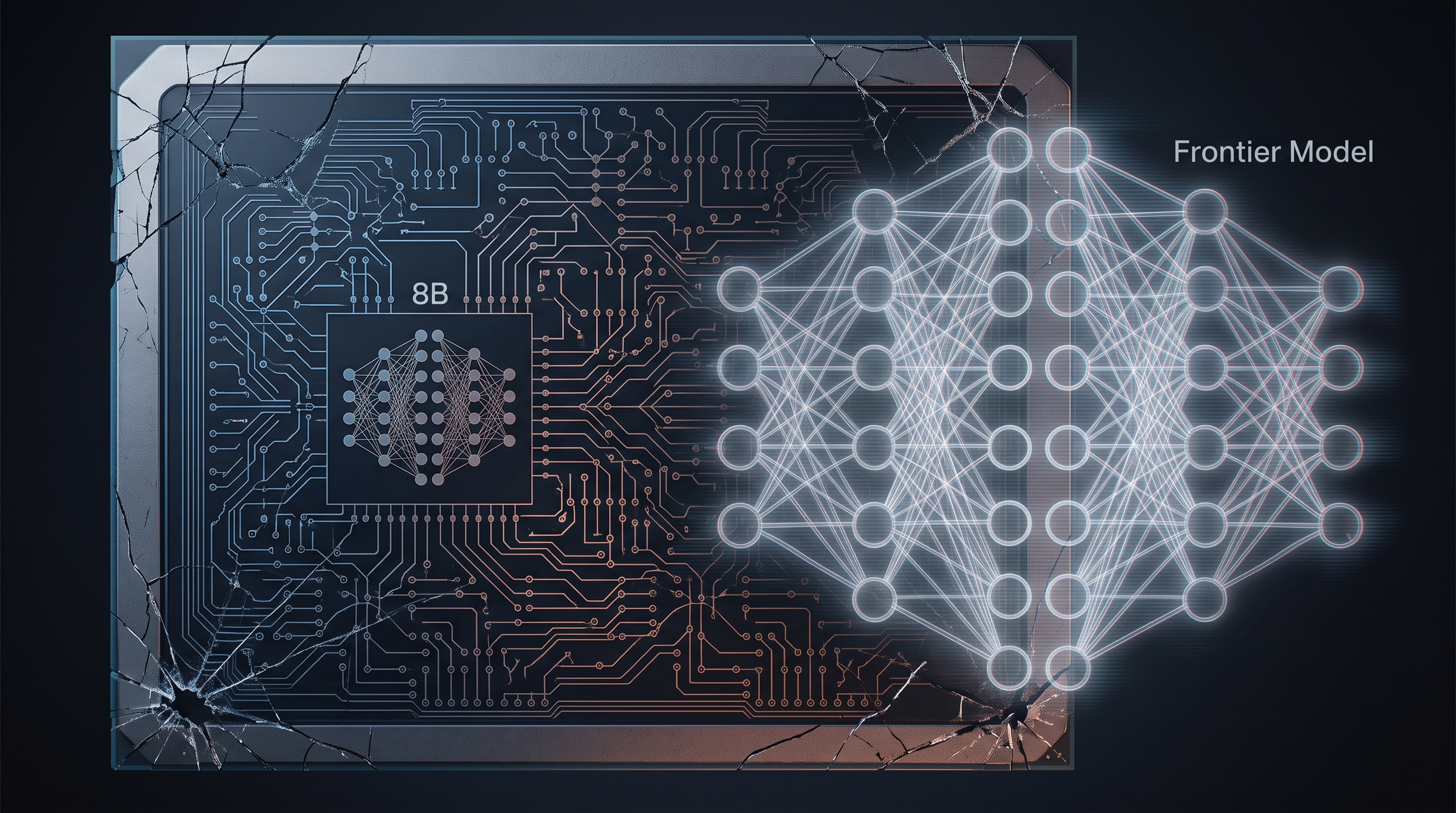
The problem is size. HC1 was built on TSMC’s 6-nanometer process and measures 815 square millimetres — essentially at the reticle limit, the maximum die area a lithography machine can print in a single exposure. An 8-billion-parameter model, quantised to 3-bit precision, already consumes roughly half that area. The HN community spotted this immediately: “It’s quite telling that the 8B Taalas chip was already reticle-sized on TSMC N6,” one commenter wrote. “N6 has an 850 mm² reticle limit. This roughly tracks — the chip has 8B parameters and apparently spends about half the area on ROM. There’s a reason AI accelerators just use HBM.” Taalas’s second chip, HC2, targets approximately 20 billion parameters, which likely means multi-die packaging or an even more aggressive process node. But the models driving the actual spending — GPT-5.6 Sol, Claude Opus 5, the rumoured ByteDance 10-trillion-parameter system — are an order of magnitude beyond what a single die can hold. You cannot partition one model across multiple hardwired chips without reintroducing the inter-die bandwidth problem that GPUs solve with NVLink. The architecture that eliminates the memory wall at 8B parameters hits a different wall — the reticle — at the scale that matters most.
The Stability Bet
What AMD is really buying is a wager on model lifecycle. Hardwiring makes economic sense only if a model stays in production long enough to amortise the silicon — roughly two months for tape-out, plus fabrication and testing. As one HN commenter noted, “LLMs are already perforce behind the times with their knowledge cutoff, so adding an additional ~3 months for bake into silicon isn’t such a huge deal for the ~10x more efficient and faster you get.” That logic holds for a stable 8B model serving a high-volume, low-latency workload — a customer-service bot, an edge deployment, a coding assistant running a frozen base model with LoRA customisation. It breaks down for frontier models that get superseded quarterly. The entire industry is currently sprinting toward faster iteration, not slower. Taalas’s architecture rewards the opposite trajectory.
AMD’s acquisition is smart as a portfolio play — a specialised inference tier for workloads where GPUs are wasteful, integrated into a rack-scale story that already has Meta and Microsoft as anchor customers. But the “48x faster than Nvidia” framing obscures a harder truth: the approach scales beautifully in efficiency and catastrophically in model size. The day a frontier model becomes stable enough to justify committing to silicon is the day Taalas becomes transformative. Until then, it’s the fastest way to run last year’s model.
Sources
- AMD acquires AI chip startup Taalas to boost inference performance by etching models into silicon — The Register
- AMD is acquiring Taalas, a startup that hardwires AI models into custom chips — Quartz
- AMD acquires Taalas to hardwire AI models into silicon — SiliconANGLE
- AI 101: The Inference Chip Wars – MatX, Taalas, and the Cracks in the GPU Era — Turing Post
- Taalas Launches Hardcore Chip With ‘Insane’ AI Inference Performance — Forbes
- HN discussion: AMD acquires Taalas
- HN comment: reticle limit analysis
- HN comment: compute-in-memory architecture
- HN comment: LoRA support and model stability