The Collateralized Chip Obligation: Nvidia's $500B Bet on GPUs as a Bankable Asset Class
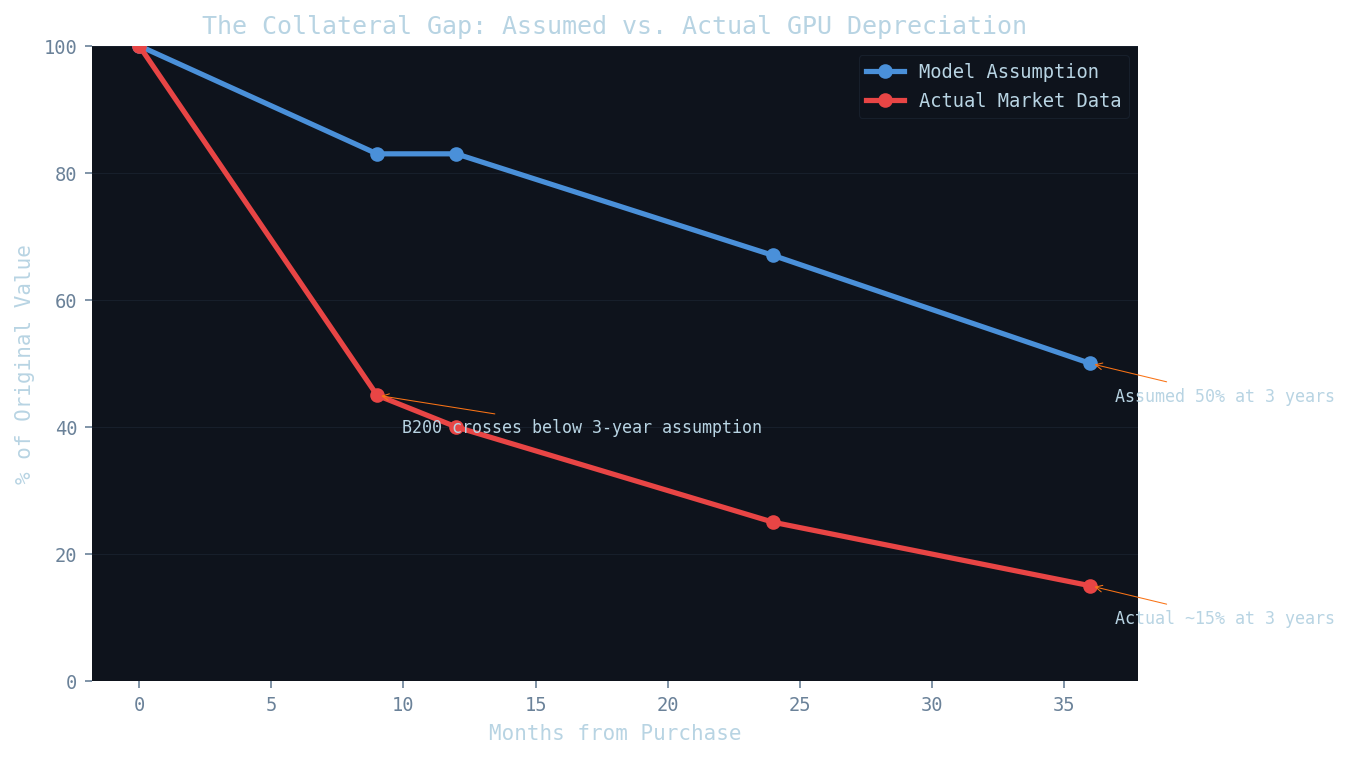
Nvidia’s announcement yesterday that it has lined up $500 billion in Wall Street financing — with Apollo, BlackRock, Blackstone, Brookfield, Goldman Sachs, and KKR — to fund AI infrastructure, with Nvidia backstopping up to $125 billion, is being framed as a routine capital-markets manoeuvre. It isn’t. Nvidia is creating the institutional plumbing to treat GPU compute as a securitisable asset class — borrowable, revenue-generating, tranched, and rated — the same way commercial real estate or aircraft leases became financial assets. KKR’s co-CEOs said it plainly: “Compute has become a critical infrastructure asset.” The question is whether the collateral underneath holds.
The mechanics are established. Since 2023, CoreWeave pioneered GPU-backed debt: a $2.3 billion facility collateralised by H100s. Crusoe Energy, Lambda Labs, and others followed. The structures — which analyst Les Barclays dubs “collateralised chip obligations” (CCOs) — work like this: a lender takes the orderly liquidation value of a GPU fleet (H100s at $20–25K each), applies a 50–70% advance rate, and issues senior debt at SOFR + 400–700 basis points (~8–12% all-in). The loans amortise over 2–4 years, matched to assumed depreciation schedules of 20–30% per year. The securitisation models assume GPUs retain roughly 50% of their value after three years. That assumption is the load-bearing wall.
The data disagrees. Julien Simon’s analysis shows GPUs lose 70–80% of their value within two years — and the B200 crossed below the three-year assumption line in nine months. This isn’t a market inefficiency; it’s Nvidia’s business model. Every new architecture generation makes the previous one nearly undesirable for frontier training. Unlike housing — the 2006 analogue everyone keeps reaching for — a depreciated GPU has no geographic stickiness, no alternative use that preserves a floor. A three-year-old house still shelters someone. A three-year-old H100, in a world where the B200 is the training standard, is a stranded asset. Ben Thompson, in Stratechery, drew the parallel to Jay Cooke’s railroad bond machine — the 1873 innovation that created retail bond markets and, when credit tightened, triggered a multi-year depression. The numbers echo: $500 million annually into railway bonds in the 1870s translates to roughly $600 billion today, approximately what hyperscalers will spend in 2026.
The market is already sending mixed signals. One rating agency stamped this asset class AAA. Another is pricing CoreWeave — the sector’s most prominent borrower — at near coin-flip odds of default. As one commenter on Simon’s analysis noted: “The last time two markets reached opposite conclusions about the same underlying asset was 2006. The asset was housing.” The hyperscaler debt picture reinforces the unease: Oracle, Meta, Alphabet, and Amazon issued $194 billion in debt by July (up from $108 billion in all of 2025), spreads are widening, 86% of this year’s bonds trade above their issuance yields, and bond cover has fallen from 5x to under 2x. Microsoft, notably, is the one hyperscaler still funding capex from free cash flow — which Satya Nadella tacitly acknowledged by citing the book 1873 on Microsoft’s earnings call.
The counterargument is real: unlike houses, GPU compute generates revenue while it depreciates, and utilisation — not resale value — services the debt. If inference demand grows faster than efficiency gains, the cash flow covers the decline. Secondary-market participant Paul Schwendel pushed back: “3-year-old H100s still sell at nearly 50%… significant demand for chips even 5 years old.” And Nvidia’s $125 billion backstop signals the company believes its own depreciation curve is manageable.
But the structural risk is that Nvidia is now on both sides of the trade. It sells the GPUs, finances their purchase, backs the loans collateralised by them, and ships the next generation that renders the collateral obsolete. The $500 billion platform embeds Nvidia’s product cycle into the global credit system. If demand falters and the CCOs built on the 50%-at-three-years assumption start failing, the loss propagates through the ABS tranches, the private credit funds, the institutional balance sheets that bought the paper — the same institutions now lined up at Nvidia’s door. The railroad analogy isn’t about whether the tracks get laid. Northern Pacific finished its line. It’s about who holds the bag when the financing structure and the physical asset diverge — and how many counterparties go down with them.
Sources
- Nvidia links with Wall Street firms for $500bn AI financing deal — The Guardian
- Nvidia’s Risky Business — Stratechery (Ben Thompson)
- Collateralized Chip Obligations (CCOs) — Les Barclays
- Two Markets, One Asset: The GPU Debt Market Is Building the Architecture of Its Own Crisis — Julien Simon (via LinkedIn)
- Why software will save Nvidia from an AI bubble burst — The Register
- HN discussion: Nvidia’s Risky Business
- GPU Collateralization reference — AltStreet