The Ban France Couldn't Pass and Australia Couldn't Enforce
France’s Constitutional Council struck down the country’s under-15 social media ban on Friday, ruling that requiring everyone — including adults — to prove their age before accessing online services “disproportionately infringes upon freedom of expression and communication” while failing to provide legal safeguards for privacy. The decision is a sharp rebuke to President Emmanuel Macron, who pushed the law as the European counterpart to Australia’s world-first under-16 ban. Macron has ordered his prime minister to rework the legislation before spring 2027, but the court’s reasoning targets the ban’s structural core, not a fixable detail: any age-gating system comprehensive enough to keep children off platforms necessarily becomes an identity-verification apparatus covering the entire user base. That’s the constitutional problem, and no rewrite easily escapes it.
The court’s intervention matters because France was meant to be the proof-of-concept that Australia’s experiment could export. Australia barred under-16s from ten major platforms in December 2025. Indonesia, Malaysia, Greece, Denmark, and the UK have all announced or drafted similar restrictions. France was first in Europe to pass one. But the Constitutional Council identified what the political momentum had glossed over: a child-access ban and a universal age-verification regime are the same policy. You cannot gate children without gating everyone, and the French court wasn’t willing to let that happen without privacy guarantees the legislature hadn’t written.
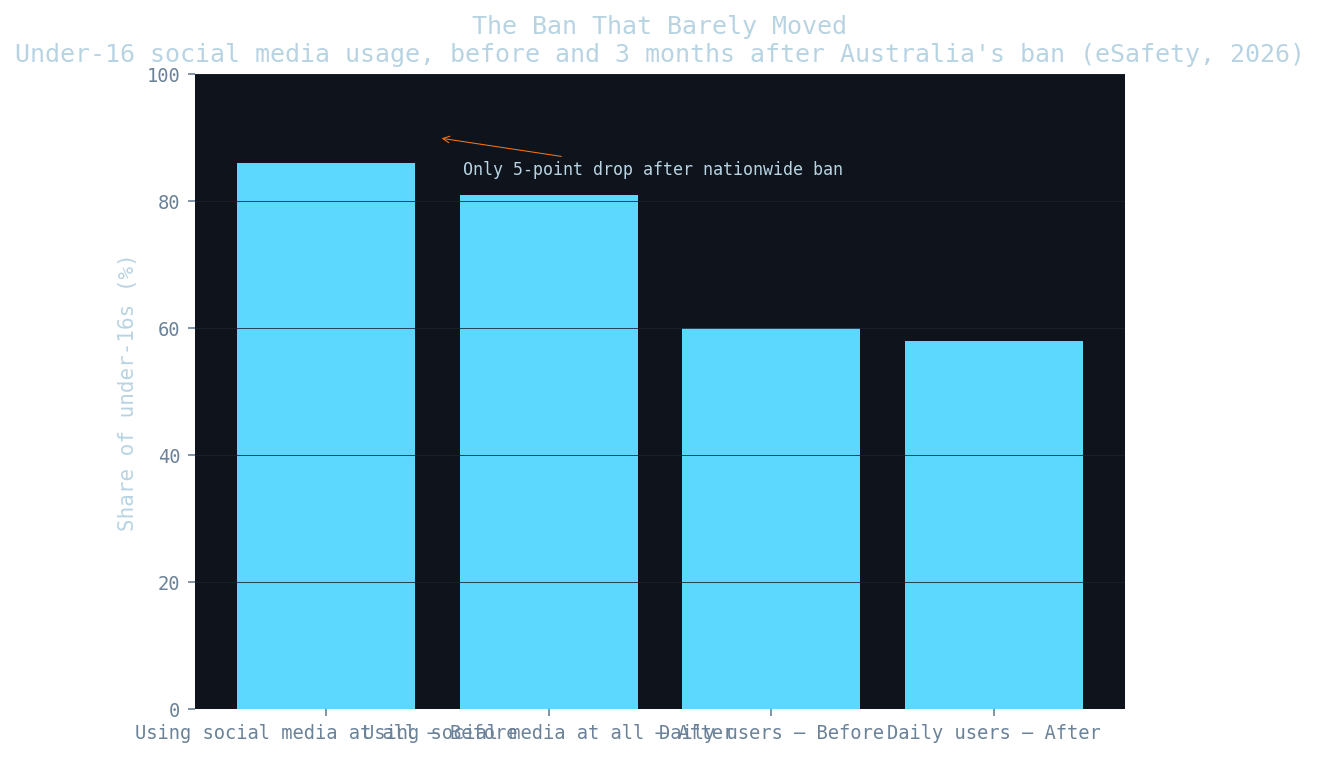
The Australian enforcement data makes the French court’s caution look well-placed. In August, eSafety — Australia’s internet regulator — published a study finding that more than 81% of under-16s were still using social media three months after the ban, down only marginally from 86% before it took effect. Daily use dropped from roughly 60% to 58%. About half the children who retained accounts said platforms hadn’t checked their age at all; others used accounts registered as 16+ or beat flawed age-estimation systems. The government had announced 4.7 million account revocations by January, but teenagers simply opened new ones. Communications Minister Anika Wells’s defence — “we never expected 100% compliance” — is technically honest but strategically revealing: a policy that moves usage from 86% to 81% has not meaningfully changed access. It has changed the conversation, as assistant minister Andrew Leigh put it, but the conversation is not the outcome.
The Hacker News discussion on the French ruling surfaced the core tension directly. One commenter observed that “any age verification system effectively becomes an identity verification system. And such tools rarely remain ‘just for kids’ — they quickly become used for other purposes.” Another pushed back with the smoking analogy: teen smoking fell from ~36% in the 1990s to ~2% today, suggesting that imperfect barriers still produce results over time. The counter to that counter is that cigarette age-checks happen at a physical point of sale with a human glance at a face; online age verification requires no such locality and creates a permanent, reusable proof-of-age record that the French court — and EU data protection law — treats as a categorically different intrusion.
The deeper story is that the global social media ban movement has a model problem, not just an enforcement problem. The policy’s political appeal is obvious: it lets governments appear decisive on a genuine public health concern without regulating platform design, algorithmic amplification, or the addictive features that actually drive harm. Australia proved the political sales pitch works. It has not yet proven the policy works. France’s court has now forced the question that Australia’s legislature never seriously confronted: whether the privacy cost of universal age-gating is worth a five-point reduction in usage. Macron will try again, and the UK and Denmark will watch closely. But every iteration will hit the same wall — the one the French court just named.
Sources
- French court blocks Macron’s social media ban for under-15s — The Guardian
- France’s constitutional authority strikes down social media ban for under-15s — France 24
- Australia’s under-16 social media ban failing, study shows — Al Jazeera
- Most Australian teens still online three months after under-16 ban — Al Jazeera
- France’s top court blocks social media ban for under-15s (HN discussion) — Hacker News
- Social media ban for under-15s: Why everyone in France will soon have to verify their age — Le Monde