The Notebook With the Unreliable Index: Why AI's Memory Advantage Is Real and Overstated
The Memory Asymmetry That Isn’t What You Think
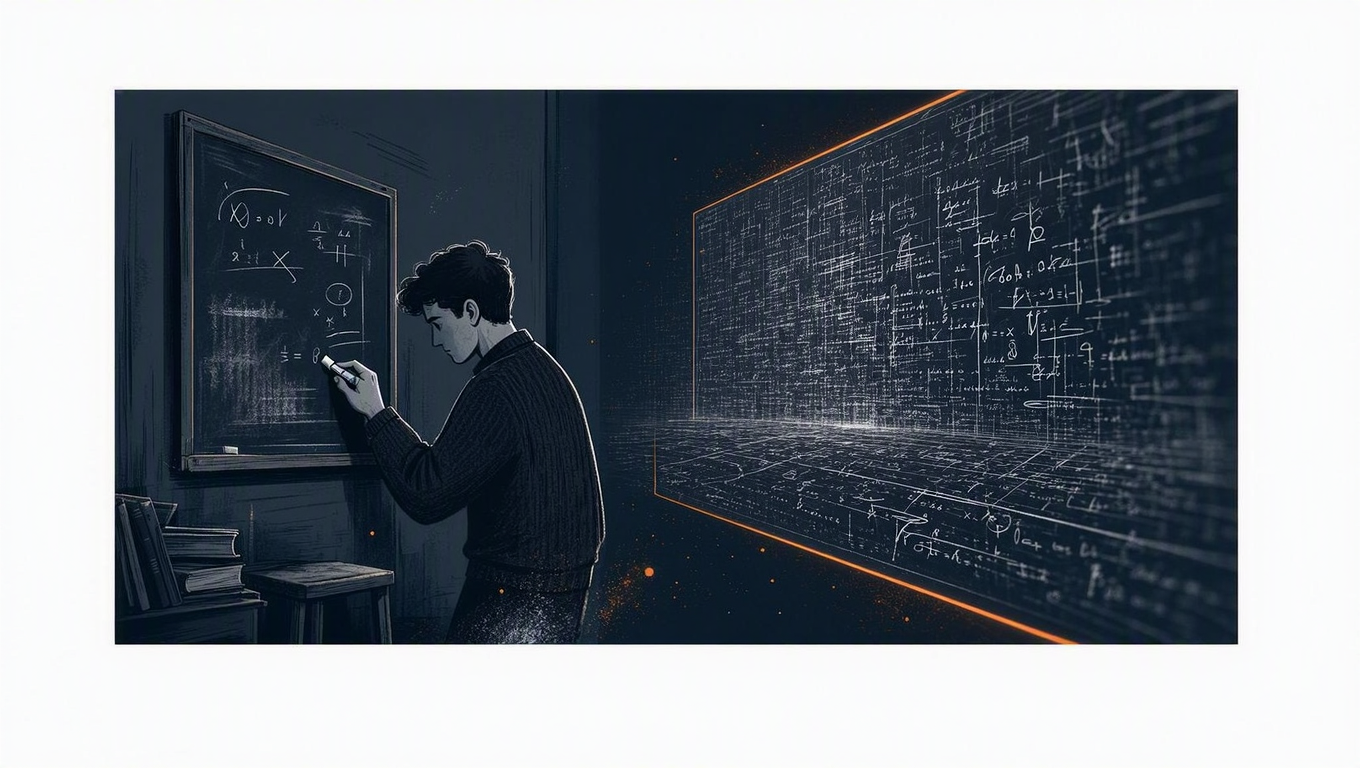
When a frontier model solves a competition-level math problem that would stump a Fields medalist, the default interpretation is breakthrough reasoning. Davide Piffer’s widely discussed essay offers a different read: AI’s edge in mathematics isn’t superior thinking but a vastly larger symbolic workspace. The context window, he argues, is a “gigantic external notebook” that removes the working-memory bottleneck constraining every human mathematician. It’s an elegant thesis — and it’s half right in a way that makes the wrong half more interesting.
Piffer grounds the argument in cognitive psychology. Human working memory holds roughly four to seven unfamiliar elements; chunking compresses but doesn’t eliminate the limit. Studies by Alloway and Passolunghi (2011) and Blankenship et al. (2015) show working memory predicts mathematical performance even after controlling for IQ. If biological working memory caps human math, then a machine with a 200K-token context window isn’t playing the same game — it’s playing a game where the binding constraint has been removed. Paper doesn’t make you smarter, Piffer notes; it expands effective working memory. The context window is paper at industrial scale.
The Problem: The Notebook Isn’t As Reliable As It Looks
The essay’s weakness is that it treats the context window as a faithful extension of working memory — a vast, stable scratchpad. Empirical evidence says otherwise. Chroma Research’s 2025 study of 18 frontier models found continuous accuracy degradation at every increment of context growth, not just at the limit. A 200K-token window can show serious accuracy drops well before saturation, with a “lost-in-the-middle” effect where information buried mid-context is retrieved poorly. The advertised context length is not the usable context length. The notebook is enormous, but its later pages are smudged.
This matters because Piffer’s framing implies the memory advantage is clean and additive — remove the bottleneck, get proportionally better math. In practice, the model’s ability to use its externalized memory degrades as it grows. The working-memory analogy also glosses a deeper distinction: humans maintain a private, continuously updated mental state — we can hold a number, transform it, replace it silently. Standard LLMs are much weaker at this; their most stable memory is the token sequence already emitted, which means the reasoning is externalized into text that may or may not be re-attended to correctly. It’s less “unlimited working memory” than “a very large notebook with an unreliable index.”
Contamination Complicates the Story Further
There’s a second problem Piffer doesn’t address. The “reasoning vs. memorization” question has a more literal sense in the ML literature: benchmark contamination. The AAAI 2026 paper “Reasoning or Memorization? Unreliable Results of Reinforcement Learning Due to Data Contamination” (arXiv:2507.10532) demonstrates that RL-tuned models’ gains on mathematical benchmarks may be partly artifacts of training data containing the test problems themselves. This is memorization in the straightforward sense — the model has seen the answer before — not the cognitive-architecture sense Piffer means. Both senses erode the “AI is reasoning” claim, but they point to different fixes. Contamination requires clean benchmarks; the memory-capacity thesis requires rethinking what we’re measuring.
The HN community was characteristically impatient with the essay’s framing. One commenter dismissed it without reading: “Anybody knowledgeable in the field should be familiar with AI writing tells… I expect any competent writer to avoid slop phrasing in their titles.” The reflexive dismissal is unfair — the cognitive-psychology grounding is legitimate — but it reflects a real fatigue with the “AI doesn’t actually reason” genre, where the argument keeps shifting between contamination, memorization, pattern-matching, and now memory capacity without converging.
The Useful Core
Strip away the overclaim and Piffer identifies something real: mathematical performance is not a unitary quantity called “intelligence.” It’s a composite of reasoning, memory, search breadth, and tool use, and different cognitive architectures distribute those components differently. The context window genuinely changes what’s possible — keeping dozens of constraints, abandoned approaches, and intermediate lemmas simultaneously visible is a capability no human has. But calling this “out-remembering” rather than “out-thinking” imposes a false binary. Externalized symbolic memory is a form of thinking for systems whose reasoning occurs through token generation. The more honest framing: AI doesn’t outthink or out-remember mathematicians. It operates in a different cognitive regime where the boundaries between memory and reasoning don’t map onto human categories at all. The interesting question isn’t which faculty is responsible — it’s whether our benchmarks, designed to measure human-style mathematical reasoning, are even calibrated for a system whose cognition works this differently.
Sources
- AI Isn’t Outthinking Mathematicians. It’s Out-Remembering Them — Davide Piffer
- Reasoning or Memorization? Unreliable Results of Reinforcement Learning Due to Data Contamination — arXiv, AAAI 2026
- Context Rot: How Increasing Input Tokens Impacts LLM Performance — Chroma Research (2025), via Morph
- Working Memory in LLMs: Context Window Deep Dive — Atlan
- HN Discussion: AI Isn’t Outthinking Mathematicians