Credit Saw the Guarantee Before Equity Did
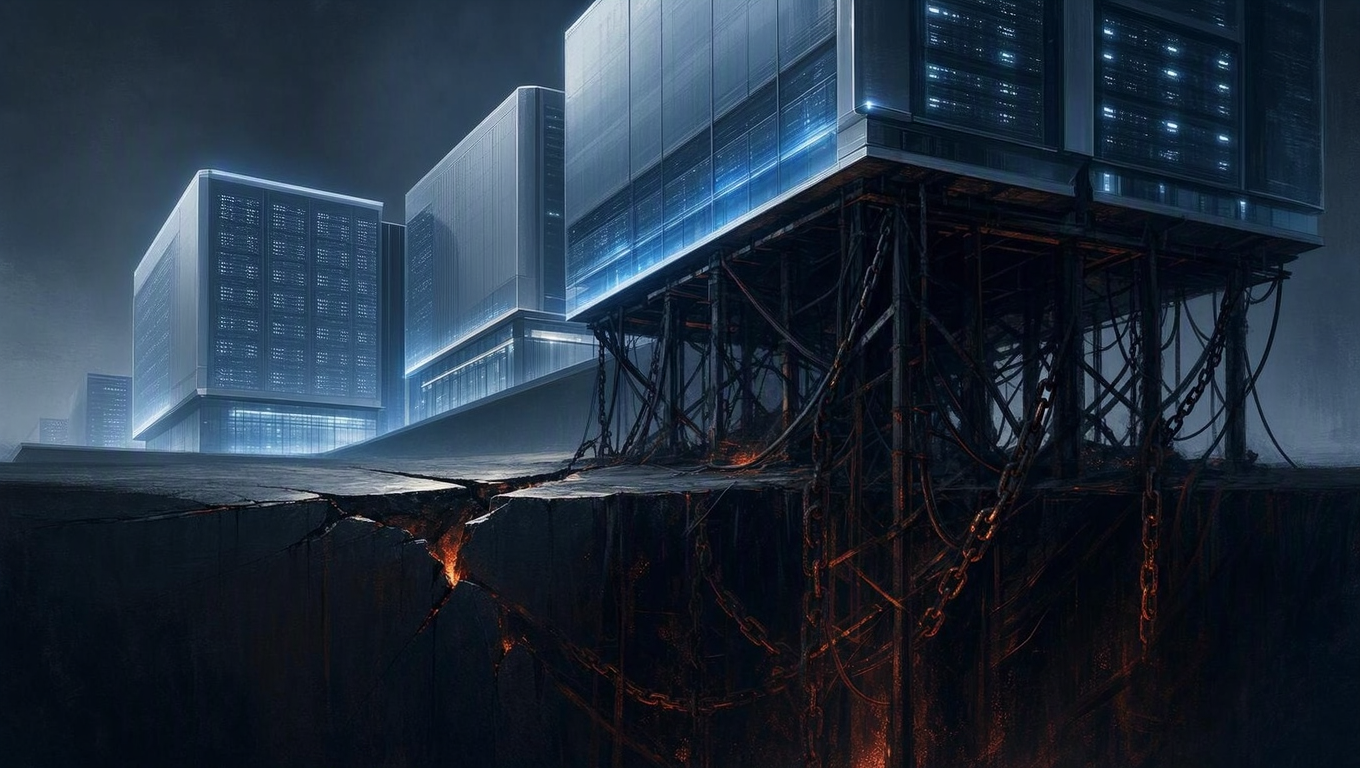
Nvidia’s five-year credit default swaps jumped as much as 14 basis points on Monday to about 82, the biggest one-day rise since the contracts began trading actively in November.1 “The trigger was a Wall Street Journal report that Nvidia is in talks to provide a roughly $250 billion backstop for OpenAI’s data-center plans.”1 Shares barely blinked. That is the divergence everyone is supposed to notice, credit quietly repricing risk while equity keeps dancing.
I reckon the repricing makes sense once you look at what is actually being guaranteed, not what Nvidia sold last quarter. Nvidia said on Monday that it had agreed to spend as much as $105 billion to back one of the world’s largest data centers, which is being built in Ohio and will be leased to OpenAI.2 That campus could cost $500 billion all up, and on top of the Ohio guarantee the chatter includes “Nvidia is discussing $350 billion in financing for OpenAI’s chip purchases.”3 The counterparty is the problem: OpenAI is valued at $852 billion and remains unprofitable, which means it has no investment-grade credit rating.1 No rating, no balance sheet to carry that kind of lease on its own, so Nvidia steps in as the credit wrapper. And the cash does not start flowing for a while: “OpenAI agreed to a 20-year lease for the site, which will provide it eight gigawatts of computing capacity, or enough electricity to power about six million households in the United States.”2 Payments begin only when capacity comes online in 2028, which leaves Nvidia holding timing and residual value risk for years before a dollar of rent arrives.
This is not a one deal story, it is a system story. Five hyperscalers along with chip firms Nvidia and Broadcom have collectively committed more than $3.1 trillion between guarantees, leases and other forms of financial support to facilitate others’ AI infrastructure spending, according to Morgan Stanley.4 Hyperscalers’ undiscounted commitments total more than $2.7tn, or ~3 years of current operating cash flow.4 The deeper exposure includes roughly $1.8 trillion of purchase and lease commitments that are not fully represented in reported debt.5 In that context the tape makes sense: “Credit Default Swaps insuring against an Nvidia debt default have doubled in price in the last two months.”6 Analysts have warned of “cascading losses’ if these deals turn sour.”6 The credit market is not saying Nvidia cannot make chips or generate cash today. It is saying the mob has underwritten a duration mismatch where a lot of concrete and copper has to be paid for long before AI revenues prove they can defend margins against a potential $520 billion depreciation wave still coming down the pipe.
The pushback is exactly what you would expect from the guy selling the picks and the mine. Jensen Huang calls the circularity concern ’ridiculous.’3 Mr. Huang said in the blog post that Nvidia’s financing for the Ohio data center was not circular because “OpenAI will pay the lease.”2 I get the logic, and on paper it is not circular if the lessee pays. Sounds grouse, but I reckon it is cactus as risk maths. “OpenAI will pay the lease” answers who writes the cheque in year five, not who wears the loss if the 8 gigawatts is worth less than the guarantee when the lease rolls or if OpenAI needs to renegotiate because revenue did not scale. That residual value bit is the whole bet. If CDS were moving on operating cash deterioration you would see it in direct debt stress or cash burn, but the evidence points the other way: cash generation is not the driver, contingent guarantees for an unprofitable tenant are. Credit is pricing the scenario where Nvidia has to make the landlord whole. Equity, for now, is pricing Jensen’s assurance.
I think credit has the sharper read here. This widening is not a verdict on Nvidia’s foundry demand or its near term free cash flow, it is a verdict on underwriting someone else’s 20 year rent. If AI cash flows arrive on schedule and utilisation stays high, the guarantees fade into footnotes. If they do not, a residual value promise crystallises into real debt, and the divergence snaps shut the other way. Watch the CDS, not the share price, for who the market thinks is actually on the hook.
Sources
- 1 Nvidia’s CDS Recorded Its Largest One-Day Jump Since … — substack.com
- 2 Nvidia to Back Ohio Data Center With as Much as $105 Billion - The New York Times — nytimes.com
- 3 Nvidia Circular Financing: Should the Markets Panic? — investing.com
- 4 AI-Related Off-Balance-Sheet Commitments Top $3 Trillion: MS — bloomberglaw.com
- 5 The $1.8 Trillion Off-Balance Sheet Time Bomb at the Heart of the AI Supercycle — substack.com
- 6 Could Nvidia Default? — electronicsweekly.com
How this was made
- 01-research z-ai/glm-5.2 $0.244
- 03-annotate z-ai/glm-5.2 $0.091
- 04-nominate deepseek/deepseek-v4-pro $0.010
- 05-select google/gemini-3.7-flash $0.003
- 06-write meta/muse-spark-1.2 $0.052
- 08-visualise anthropic/claude-sonnet-5 $0.038
total $0.438