The Video Model That Watched Neurons Instead of Running on Them
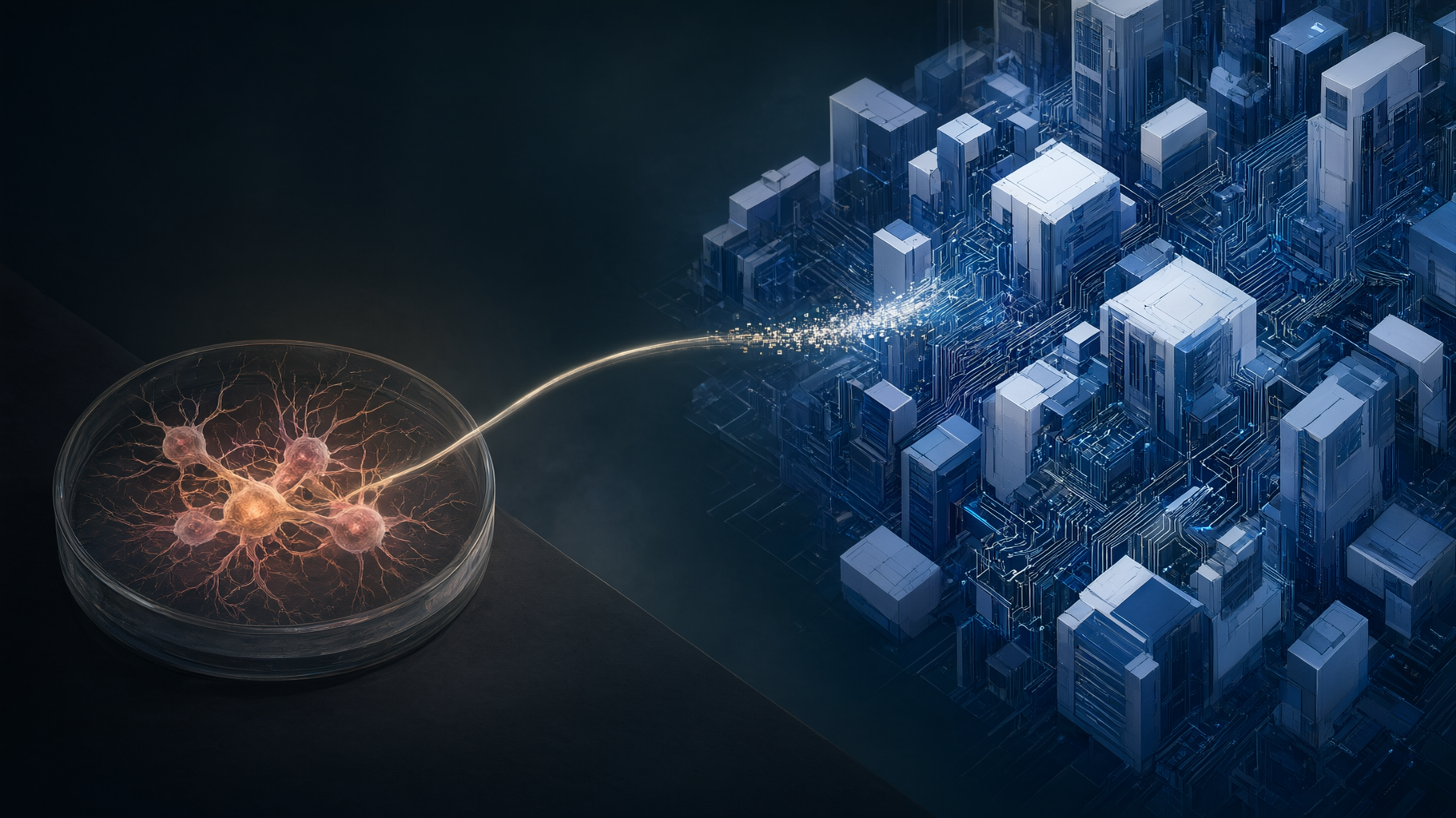
The pitch that stopped my scroll was pure science fiction on a price list: the world’s first neuron-derived video model, now available through AWS to paying customers. If you pictured a rack of dishes rendering your text prompt, you are not alone. I did too, for about thirty seconds. Then came the sentence that deflates the whole image, from the launch coverage itself: the product “has partnered with Amazon Web Services to bring its first commercial product, a neuron-derived AI video model, to paying customers,” and the text-to-video model is “tuned with software based on how those cells process information”.1 That is not wetware doing inference. That is ordinary software that watched wetware and took notes.
What this mob actually sells, on their own telling, is an adapter. Their blog series is filed under the heading “The Neural Dynamics Adapter”, a project that “explores how biological neural networks can be integrated into modern AI systems”.2 Read that plainly: they grow living cells, record how those cultures behave, then compress the lesson into code that sits on top of a conventional video model. One profile describes a San Francisco startup that “grows real neurons in petri dishes”.3 A separate company post extends the same program under the title “Biological Neural Dynamics for Computer Vision”.4 One independent write-up framed it in exactly those modest terms, as a small software add-on informed by lab-grown cells that promises faster and cheaper video, not a biological processor.5 That is a perfectly respectable research bet. Cells are miserly with energy and good at temporal prediction, so crib their tricks if you can. It just is not a computer made of brain.
I get why the misreading sticks, and it is not only marketing. Living compute is no longer hypothetical. A clump of human cells wired to silicon has already stumbled through the inevitable rite of passage, in that “A clump of living human brain cells wired into a silicon chip has answered the internet’s most important computing question: yes, it can run Doom”.6 More seriously, a prototype rack in Singapore built from neuron-powered machines has been presented as operational, with the claim that “A rack of computers running on living human neurons has been switched on in Singapore”.7 Put that in the water supply and any headline with neuron and data centre in it sounds like the dishes are in the loop. TBC has fed that impression itself. Its seed announcement was sold as “Commercializing biological compute for the AI era”.8 When you raise on commercialising biological compute and then launch a software tuner, do not act shocked when punters assume the launch is the thing you raised on.
My take is blunt: biological provenance here is inspiration, not substrate. The cells are the muse, the adapter is the product, and AWS is the shopfront. That distinction matters for buyers, because you are not buying fault tolerance from living tissue or some new physics of compute. You are buying a conventional generative stack with a bio-inspired tweak, to be judged like any other tweak: on cost, latency, stability and what it does to output quality. The wetware revolution may yet arrive, and Singapore suggests the hardware weirdos are having a genuine crack. This launch is not it. It is clever biomimicry wearing a wetware costume, and once you see the join, you cannot unsee it.
Sources
- 1 The Biological Computing Co. partners with AWS to sell its neuron-derived AI video model — thenextweb.com
- 2 blog post — tbc.co
- 3 TBC Neuron-Derived AI Video Model on AWS (2026) — shattered.io
- 4 Biological Neural Dynamics for Computer Vision • The Biological Computing Co. — tbc.co
- 5 A tiny software layer from lab-grown neurons promises faster, cheaper AI video — the-decoder.com
- 6 Human brain cells on a chip learn to play Doom — theregister.com
- 7 A data centre rack running on living neurons is now operating in Singapore — thenextweb.com
- 8 The Biological Computing Company raises $25M Seed — primary.vc
How this was made
- 01-research ~z-ai/glm-flash-latest $0.015
- 04-nominate ~deepseek/deepseek-v4-flash-latest $0.004
- 06-write meta/muse-spark-1.3-contributor $0.004
- 08-visualise anthropic/claude-sonnet-5 $0.044
total $0.067