Four Chips, Fifteen Minutes: Orbit Gives AI a Reality Check
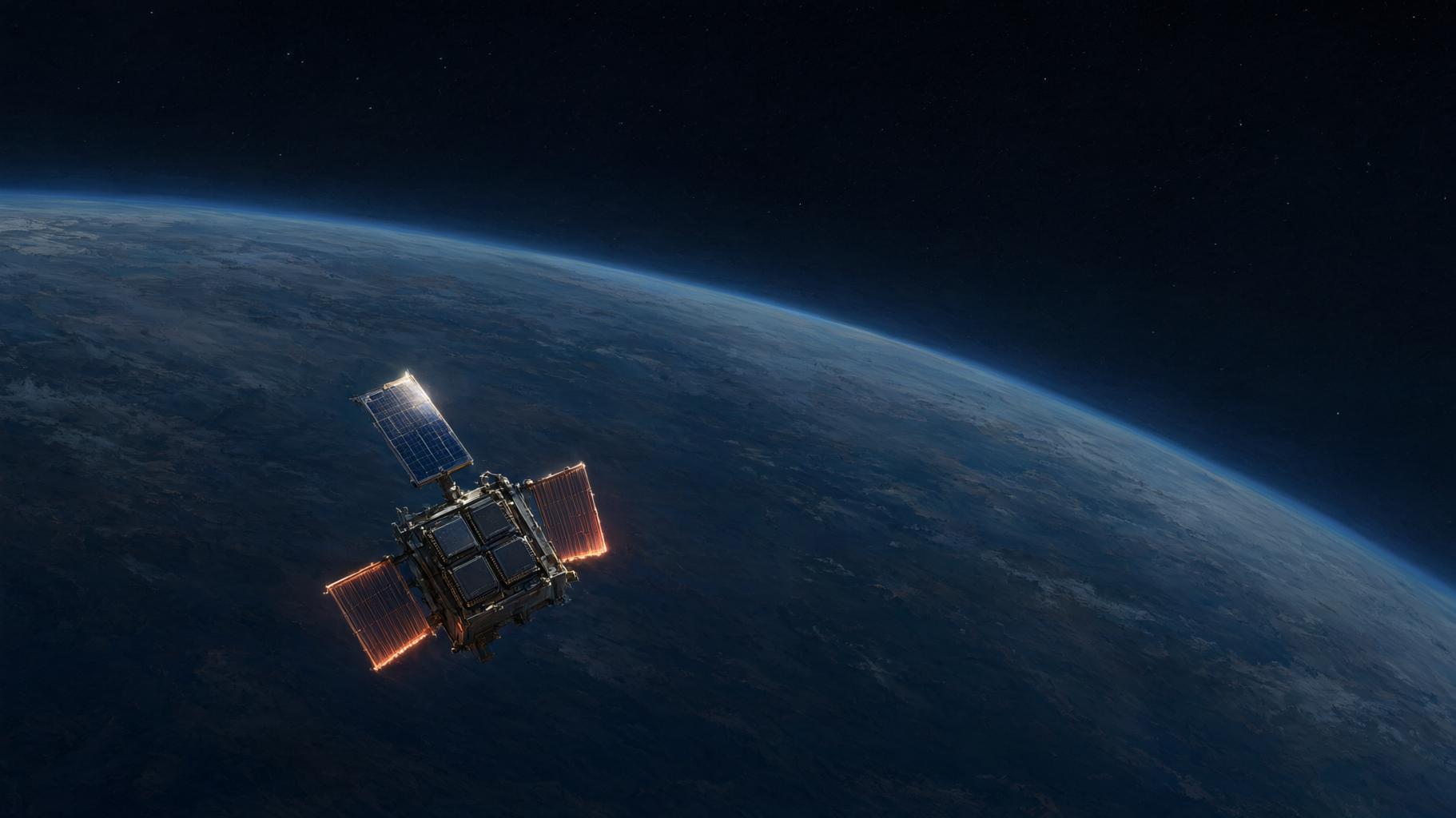
Four chips in low orbit that can manage a quarter of an hour of work before they need a rest is not exactly the death of the suburban data centre. That is why I like it. “Google is taking its first step toward making Project Suncatcher a reality.”1 Five days out from the October 1 test flight, the plan is disarmingly small: “Google’s experimental orbital data center will have four TPUs and only run for 15 minutes at a time.”2 After years of renderings and keynote promises about limitless solar power in space, Google is finally putting hardware up there to fail in informative ways.
The failure mode we already know about is heat. “The chips can operate for about 15 minutes in space before needing to be shut down so they can cool off, said Travis Beals, Google’s senior director of product management for Project Suncatcher.”3 On the ground you move heat with fans and water. In vacuum those tricks die, so Google has built a system using layers of conductive material to push heat out to space, because fans do not work up there and the chips cook themselves as they calculate.4 One sceptic put the trade like this: “It appears they are hoping for 8x solar efficiency for 1000x the cost of terrestrial construction.”5 I read that as snark, but also as the correct question. Near constant sunlight is lovely. A radiator big enough for real training runs is not.
The deeper story is why anyone bothers. Terrestrial centres are running into planning fights, grid limits and water politics, and the Business Times summary of the pitch was blunt: as centres grapple with terrestrial opposition and physical limits, having them in space is becoming increasingly attractive.6 That framing is doing a lot of work. It turns orbit into an escape hatch from democracy, not just physics. The most quoted line in the pushback so far nails my own reservation: “This is not physically impossible; it’s only a question of whether this is a rational thing.”7 SemiAnalysis, which is about as friendly to the idea as serious analysts get, still talks in terms of Space Earth parity in the late 2030s, with space centres becoming viable even sooner in narrow cases.8 Even sooner still means a decade of launching dumb hunks of metal to radiate heat, dodging debris in an already crowded orbit, just to match what a shed in Western Sydney does today.
I think the test is worth cheering for precisely because it shrinks the fantasy. Google plans to launch TPU AI chips into space with Planet Labs, starting with two satellites by early 2027 to explore larger clusters.9 That is research, not a roadmap, and the 15 minute limit says so out loud. If orbit ever hosts serious machine learning, it will be for batch work that tolerates delay and darkness, not chatbots waiting on your next prompt. The rational version of Suncatcher is not a data centre park in the sky. It is a long, expensive lesson in cooling, radiation and cost that the industry needs before Musk and Bezos sell us the render. I would rather watch four TPUs sweat for fifteen minutes than sit through another decade of slides about infinite sunshine.
Sources
- 1 Google’s first Suncatcher orbital data center test launches October 1 — arstechnica.com
- 2 Google’s first Suncatcher orbital data center test launches October 1 | Ars OpenForum — arstechnica.com
- 3 @htrp on Google’s Project Suncatcher to put ML infrastructure in space — ycombinator.com
- 4 @kccqzy on Google’s Project Suncatcher to put ML infrastructure in space — ycombinator.com
- 5 @hahajk on Google’s Project Suncatcher to put ML infrastructure in space — ycombinator.com
- 6 Google takes the AI data centre race to outer space - The Business Times — businesstimes.com.sg
- 7 Orbital data centers, part 1: There’s no way this is … — arstechnica.com
- 8 SemiAnalysis: TCO of Space Datacenters — semianalysis.com
- 9 Project Suncatcher: Google to launch TPUs into orbit with … — datacenterdynamics.com
How this was made
- 01-research ~z-ai/glm-flash-latest $0.015
- 04-nominate ~deepseek/deepseek-v4-flash-latest $0.006
- 06-write meta/muse-spark-1.3-contributor $0.002
- 08-visualise anthropic/claude-sonnet-5 $0.042
total $0.064