The Hands Inside the Humanoid Boom
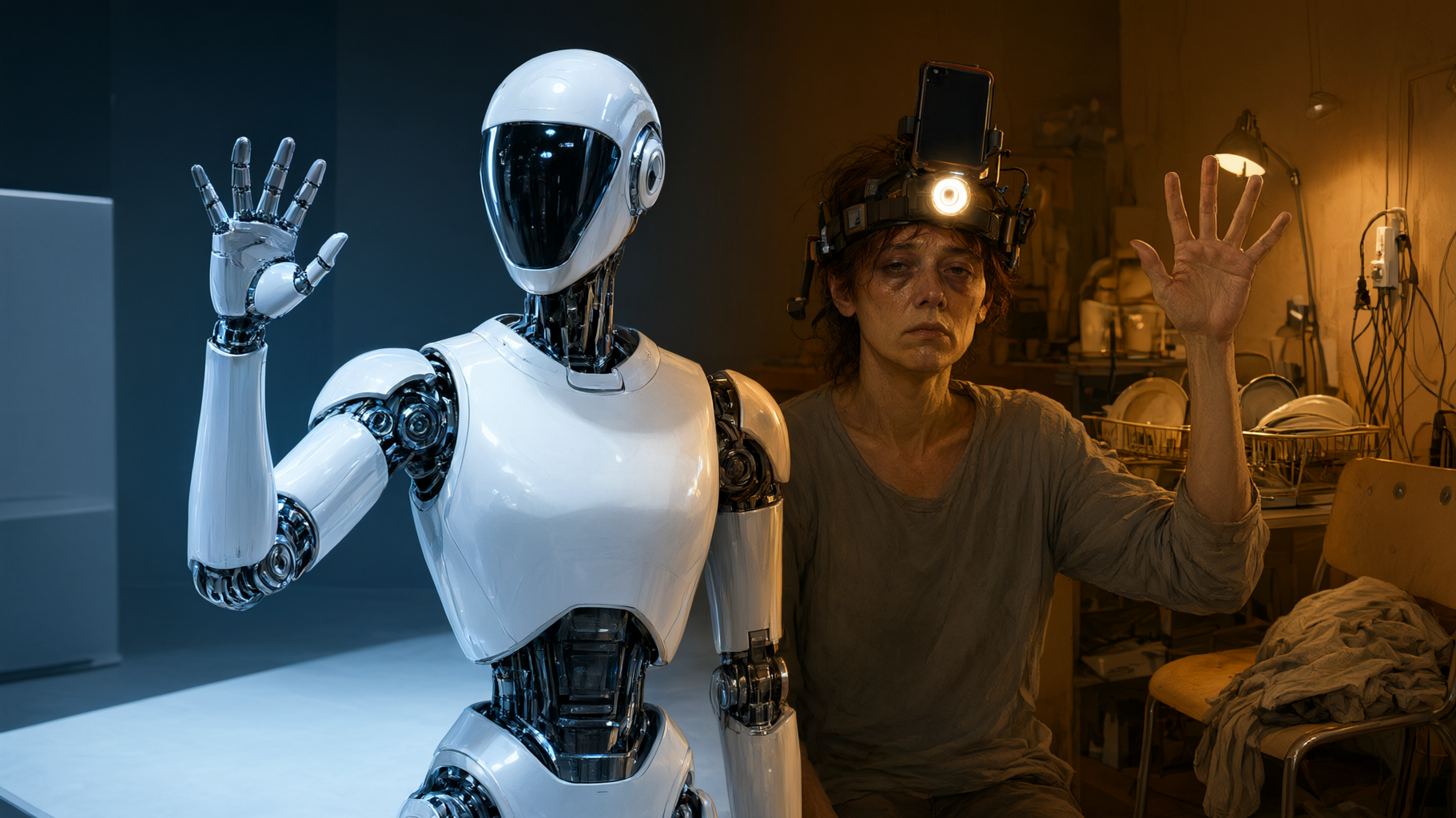
When Zeus finishes a long day at the hospital he goes home, turns on his ring light and keeps working. MIT Technology Review describes how “People in Nigeria and India are strapping iPhones onto their heads and recording themselves doing chores” and Zeus, a medical student in central Nigeria, “straps his iPhone to his forehead, and starts recording himself”.1 I reckon that image should replace every glossy demo video in your head. The future of the humanoid is not a lab in Palo Alto. It is a bloke in a studio flat doing the dishes for the dataset.
Tesla is the loudest version of the same story. Ars Technica sums up the Optimus push as a pivot straining against “complex robot hands” and staff described as “pushing back against training their robotic replacements”.2 I do not read that second bit as confirmation that anyone has been replaced, only that the fear is now part of the production line. What matters is the economics underneath. The Robot Report puts it bluntly: of the billions raised by humanoid companies in the past 18 months, “a majority of which is quietly funding hiring humans to operate robots”, which leaves the industry with “a teleoperation and data problem it keeps describing as a labor solution”.3 That is not a side cost. That is the business model, people in mocap rigs, people driving robots remotely, people filming chores, all feeding systems sold as autonomous.
The industry prefers to call this a labour solution, but that framing stuck with me because it names the trick. Teleoperation is framed as temporary scaffolding, data collection, human in the loop, while in practice it is the product. The pushback is real enough on two fronts. Tesla still talks scale, with one report noting that “Tesla aims for 1,000 Optimus robots per week by end of 2026”.4 Against that, iRobot founder Rodney Brooks warns that humanoids “won’t learn dexterity from video alone”, with hidden safety challenges attached.5 His longer essay carries the sharper title: “Why Today’s Humanoids Won’t Learn Dexterity”.6 I take that as the technical ceiling to set beside the factory target. You can build a thousand bodies a week and still not have a thousand workers, if dexterity does not transfer from footage.
I think the human labour account of humanoids is basically right, and stronger than the usual AI story admits. The money is not mainly buying autonomy, it is renting bodies to imitate autonomy until the numbers look plausible. That does not mean humanoids are fake, or that teleoperation never bootstraps something better. It means the road to robots that replace humans currently runs through hiring a lot more humans, scattered from Fremont to Nigeria, to wear the head strap and do the chore twice. If that labour gets cheaper, better managed and invisible, the boom continues. If those workers start asking what exactly they are training, as the Tesla grumbling suggests, this mob has the same problem every automation wave has. The replacement still needs a demonstrator, and the demonstrator has started to notice.
Sources
- 1 The gig workers who are training humanoid robots at home | MIT Technology Review — technologyreview.com
- 2 Tesla workers balk at training Optimus humanoid robots as replacements - Ars Technica — arstechnica.com
- 3 How to avoid the teleoperation trap in robotics development - The Robot Report — therobotreport.com
- 4 Tesla workers balk at training Optimus humanoid robots as replacements | Page 2 | Ars OpenForum — arstechnica.com
- 5 Why iRobot’s founder won’t go within 10 feet of today’s walking robots - Ars Technica — arstechnica.com
- 6 writes — rodneybrooks.com
How this was made
- 01-research ~z-ai/glm-flash-latest $0.007
- 04-nominate ~deepseek/deepseek-v4-flash-latest $0.004
- 05-select ~google/gemini-flash-latest $0.008
- 06-write meta/muse-spark-1.3-contributor $0.004
- 08-visualise anthropic/claude-sonnet-5 $0.043
total $0.065