Memory's AI Carve-Up Leaves PCs Paying
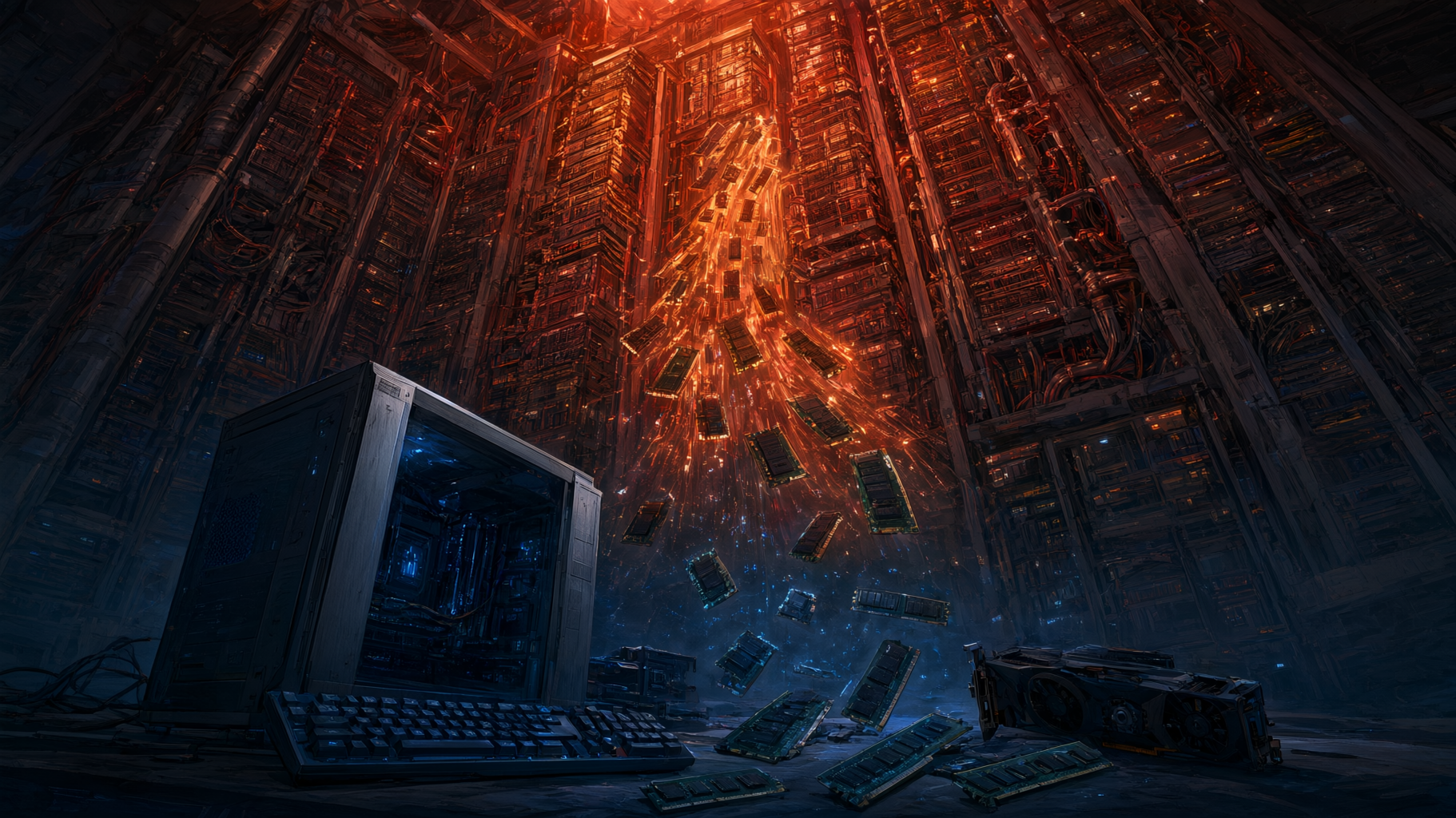
PC gamers copped it first, and I reckon that is the tell. One US tech site argues memory suppliers “just blew a hole in the PC gaming industry” as they shift to AI, with enthusiasts hit first and everything else next.1 That rings true because the pain is already moving from sticks of RAM to whole machines, with memory and processor shortages expected to push up PC prices.2 Micron now expects memory supply to get tighter in 2027 and 2028.3 I read that not as a cyclical blip but as a rationing notice, and the industry keeps talking like one. When the memory mob starts telling you next year is already spoken for, believe them.
The detail is in who gets served first. CIO summarised Micron as saying “most of next year’s supply is already committed”.4 Ars Technica reported executives expect the crunch to run through 2028, with memory sold for 2027 “are much higher than 2026 prices.”5 Samsung and SK hynix are warning of AI-driven shortages lasting until 2027 and beyond, with “customers already reserving supply years ahead, while the wider DRAM market begins to tighten”.6 TrendForce fits the same split from the price side, finding AI server demand sustained contract price rises into late 2026 while consumer-side pressure persisted.7 By the third quarter the same tracker had AI server demand still supporting prices but gains moderating as consumer demand weakened and high base effects took hold.8 That is the reallocation story in plain sight. It is not that everyone suddenly wants more RAM. It is that hyperscalers and accelerator makers have first dibs through multi-year allocations, HBM soaks up leading-edge output and engineering attention, and conventional DRAM for PCs and phones gets what is left. Scarcity then shows up where bargaining power is weakest, which is you buying a laptop, not a bloke buying ten thousand accelerators.
The obvious pushback is textbook economics, and punters made it loudly. One commenter insisted extra HBM output would cut its price and pull capacity back to consumer RAM, ending with “Increased supply will lead to lower prices.”9 Another warned memory fabs cost billions to tens of billions and investors will not stump up without reasonable certainty of profit while everybody braces for a bubble burst.10 That caution is fair, and the cultural fallout is already showing. One punter reckons recent RAM and storage disruptions point back to dumb terminals with the real computer in the cloud.11 Another reckons big labs just want to buy the world’s GPU, RAM and storage capacity and lock it away in a dark room.12 I hear the anger in both, but anger is sentiment, not supply. The textbook fix assumes fungible capacity and patient capital. Memory is lumpy, lead times are years, and no board signs a twenty billion dollar fab because Hacker News discovered supply curves.
I still buy the reallocation thesis, with one qualification. This is not proof the AI buildout is rational or that current prices clear sensibly. One options trader called the simple bubble-burst put thesis bizarre, which tells me even the sceptics think timing this is tricksy.13 Another asked whether shortages create the same incentive structure as high prices around competition and national security, which is a sharper question than it looks.14 My take is duller and, I think, more useful. For 2027 and 2028, DRAM is no longer a commodity market where PCs compete on equal terms. It is a tiered market where AI demand sets volumes and prices, and consumer gear absorbs the volatility. If you are budgeting for hardware, assume tight and lumpy. If you are hoping cheaper HBM elegantly fixes consumer RAM, you are waiting for someone else’s leftovers to get cheap.
Sources
- 1 RAM Is Ruining Everything — theverge.com
- 2 Memory and CPU shortages to push up PC prices — theregister.com
- 3 Micron expects memory supply to get tighter in 2027 and 2028 - OC3D — overclock3d.net
- 4 Memory squeeze set to tighten through 2028, Micron says | CIO — cio.com
- 5 Memory executives expect RAM shortage to continue through 2028 - Ars Technica — arstechnica.com
- 6 Samsung and SK hynix warn AI-driven memory shortages could last until 2027 and beyond, as HBM demand explodes — customers already reserving supply years ahead, while the wider DRAM market begins to tighten | Tom’s Hardware — tomshardware.com
- 7 AI Server Demand Sustains Memory Contract Price Increases in 4Q26, While Consumer-Side Pressure Persists, Says TrendForce — trendforce.com
- 8 AI Server Demand Continues to Support Memory Prices in 3Q26, but Gains Moderate as Consumer Demand Weakens and High Base Effects Take Hold, Says TrendForce — trendforce.com
- 9 @chr15m on Samsung is expected to more than double output of its HBM4 and HBM4E DRAM — ycombinator.com
- 10 @ajnin on Samsung is expected to more than double output of its HBM4 and HBM4E DRAM — ycombinator.com
- 11 @BobbyTables2 on Spain orders blocks on Archive.today and its mirrors — ycombinator.com
- 12 @Roark66 on AI companies in race to demonstrate their model most threatening to humanity — ycombinator.com
- 13 @Maxatar on Memory Companies Have Destroyed the Consumer Market — ycombinator.com
- 14 @pfannkuchen on Micron CEO Says Memory Supply Will Be Much Tighter in 2027 and 2028 Than in 2026 — ycombinator.com
How this was made
- 01-research ~z-ai/glm-flash-latest $0.006
- 04-nominate ~deepseek/deepseek-v4-flash-latest $0.021
- 05-select ~google/gemini-flash-latest $0.007
- 06-write meta/muse-spark-1.3-contributor $0.003
- 08-visualise anthropic/claude-sonnet-5 $0.050
total $0.086